

Glaw Lake Becomes India’s 101st Ramsar Site
Source: PIB
Subject: Environment & Ecology / Geography
Why in News?
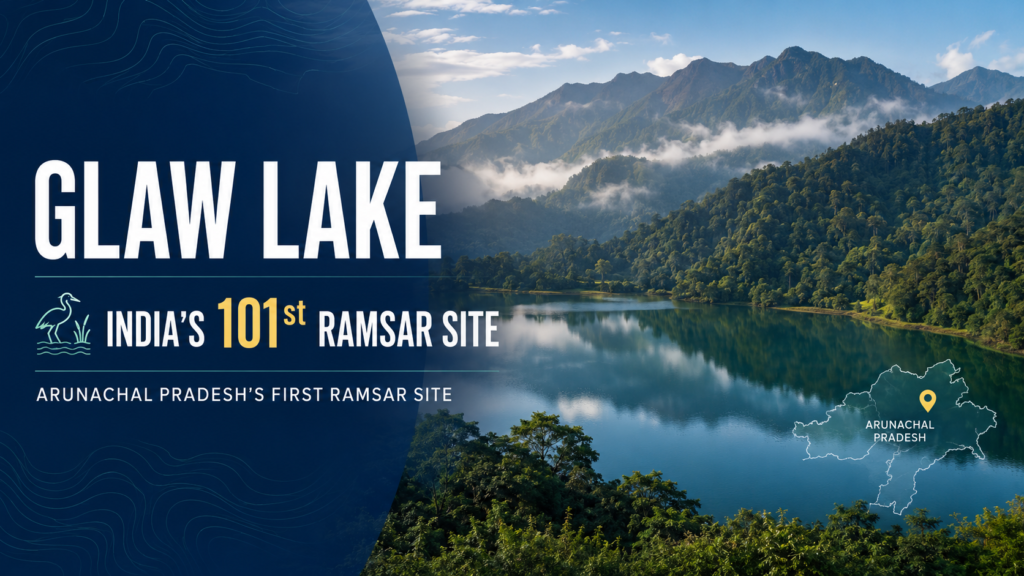
Glaw Lake, also known as Glow Lake, in Arunachal Pradesh has been designated as India’s 101st Ramsar Site. It is also the first wetland from Arunachal Pradesh to receive the Ramsar designation.
The announcement was made by the Union Minister for Environment, Forest and Climate Change on 3 August 2026. With this addition, India’s Ramsar network has expanded from 26 sites in 2014 to 101 sites in 2026. (PIB)
About Glaw Lake
- It is a pristine, high-altitude freshwater lake situated in the Wakro Circle of Lohit district, Arunachal Pradesh.
- The lake lies within the Kamlang Tiger Reserve and Wildlife Sanctuary in the Eastern Himalayas.
- It is fed by several perennial mountain streams and is surrounded by dense vegetation.
- More than 150 tree species and 49 orchid species have been recorded within the wetland and its catchment.
- The wider Kamlang landscape supports important wildlife such as the tiger, hoolock gibbon and Mishmi takin.
- Its location in the Eastern Himalayan Biodiversity Hotspot gives the lake considerable ecological importance.
Ecological Significance
Glaw Lake and its surrounding forests perform several important ecological functions:
- Conservation of freshwater and forest biodiversity
- Maintenance of local hydrological systems
- Support for water and climate security
- Protection of habitats within the Kamlang Tiger Reserve
- Support for nature-based livelihoods and responsible ecotourism
The Ramsar recognition can promote systematic monitoring, scientific management and community participation in conserving the lake.
What Is a Ramsar Site?
A Ramsar Site is a wetland recognised as being of international importance under the Ramsar Convention on Wetlands.
The Convention was adopted at Ramsar in Iran in 1971 and came into force in 1975. Its objective is the conservation and “wise use” of wetlands through national action and international cooperation. India became a contracting party on 1 February 1982.
Ramsar designation is different from a UNESCO World Heritage designation. It does not automatically create a new category of protected area under Indian law.
UPSC/HAS Prelims Facts
- Lake: Glaw Lake or Glow Lake
- State: Arunachal Pradesh
- District: Lohit
- Protected area: Kamlang Tiger Reserve and Wildlife Sanctuary
- Geographical region: Eastern Himalayas
- Status: India’s 101st Ramsar Site
- State significance: First Ramsar Site of Arunachal Pradesh
- Wetland type: High-altitude freshwater lake
Mains Relevance
Glaw Lake highlights the importance of conserving high-altitude wetlands through an integrated approach involving wetland protection, wildlife conservation, climate resilience and local communities. Future management must prevent unregulated tourism, habitat disturbance, pollution and other pressures while ensuring sustainable livelihood opportunities.
Related GS Paper: GS Paper III—Environment, Biodiversity, Conservation and Climate Change