

India’s Shakti Ki Saptadhara
Context
During the Independence Day address on 15 August 2026, the Prime Minister outlined “Shakti Ki Saptadhara”—seven strategic streams for advancing Aatmanirbhar Bharat and achieving Viksit Bharat by 2047.
What is Shakti Ki Saptadhara?
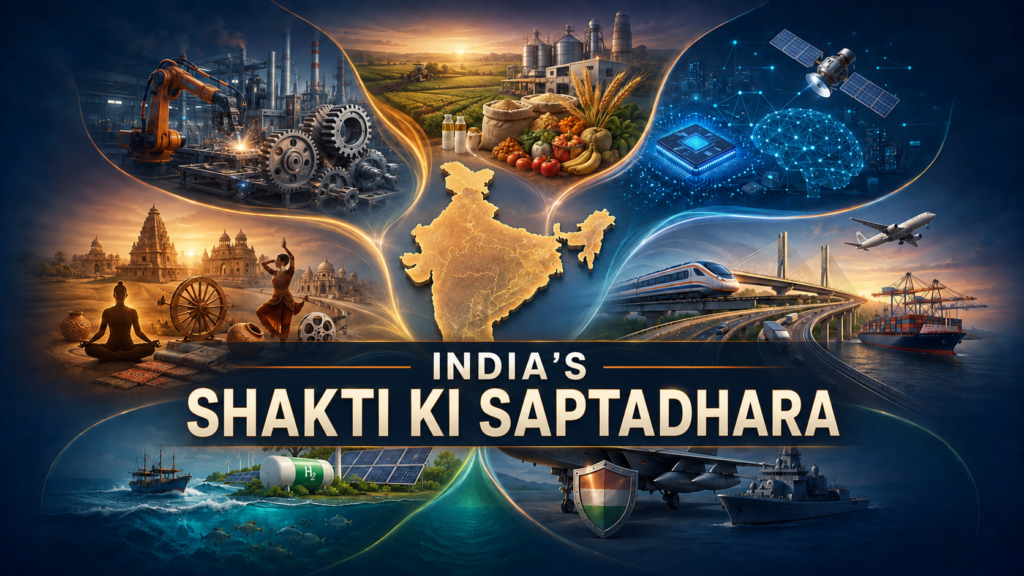
The term Saptadhara literally means “seven streams”. It draws inspiration from India’s civilisational idea of the Sapta Sindhu, while presenting a contemporary roadmap for national development.
Saptadhara is not a separate government scheme or programme. Rather, it is a broad strategic framework identifying seven areas in which India must develop globally competitive capabilities.
Its underlying idea is that national strength cannot be built through economic growth alone. Manufacturing, agriculture, technology, connectivity, defence, sustainability and soft power must reinforce one another.
Seven Streams of India’s Saptadhara
1. Manufacturing Power
Transform India into a trusted global manufacturing and supply-chain hub by developing the complete value chain—from components and product design to finished goods. The focus is on cost competitiveness, quality, scale and zero-defect manufacturing to boost employment, exports and domestic production.
2. Agriculture and Food Processing
Connect farms with global markets through food processing, value addition and exports. India can use FTAs to promote millets, spices, fruits, vegetables and traditional foods as global brands. This requires better cold chains, storage, packaging, quality certification and Farmer Producer Organisations.
3. Technology and Innovation
Develop India as an innovation hub in Artificial Intelligence, quantum technology, space, robotics, data centres and next-generation communications. Building on UPI and Digital Public Infrastructure, India aims to expand its digital solutions globally and develop indigenous technologies such as Made-in-India 6G.
4. Gati Shakti and Connectivity
Create seamless and high-speed connectivity through modern highways, high-speed rail, airports, inland waterways, multimodal logistics and port-led development. Integrated and climate-resilient infrastructure can reduce logistics costs and improve industrial competitiveness.
5. Raksha Shakti
Strengthen Aatmanirbharta in defence by developing indigenous drones, counter-drone systems, hypersonic technologies, cybersecurity and advanced defence equipment. The objective is to reduce import dependence and establish India as a reliable global defence supplier.
6. Green and Blue Economy
Promote green hydrogen, renewable energy, energy storage, green mobility and green manufacturing. The Blue Economy can generate opportunities through fisheries, coastal tourism and ocean technologies. These sectors can strengthen energy security, create green jobs and support sustainable development.
7. India’s Soft Power
Expand India’s global influence through Yoga, Ayurveda, traditional medicine, handicrafts, films, animation, gaming, digital content and tourism. India’s civilisational heritage and creative economy can complement its economic and strategic strength.
Significance of the Saptadhara Framework
Comprehensive Understanding of National Power
Saptadhara combines economic, technological, military, environmental and cultural dimensions of national strength. It recognises that these sectors cannot develop effectively in isolation.
Competitive Aatmanirbharta
Aatmanirbharta under this framework does not imply economic isolation. It means developing sufficient domestic capability to participate in the global economy from a position of strength.
Employment Generation
Manufacturing, food processing, infrastructure, renewable energy, defence production and the creative economy have considerable potential to generate both skilled and semi-skilled employment.
Strategic and Economic Security
Domestic capabilities in defence, technology, energy and critical manufacturing can protect India from geopolitical uncertainty, trade disruptions and external dependence.
Export-Oriented Development
The framework seeks to transform India from a large consumer market into a producer, innovator and global supplier of goods, services and technologies.
Sustainable Development
The inclusion of green and blue economies ensures that economic expansion remains aligned with environmental sustainability and climate resilience.
Relevance for Himachal Pradesh and the HAS Examination
The Saptadhara framework offers significant opportunities for a mountainous state such as Himachal Pradesh.
- Manufacturing: Pharmaceutical and MSME clusters in the Baddi-Barotiwala-Nalagarh region can move towards advanced, environmentally responsible and high-value manufacturing.
- Agriculture and food processing: Apples, stone fruits, off-season vegetables, millets, honey, medicinal plants and traditional foods can be strengthened through processing, branding, cold chains and exports.
- Technology: Digital connectivity, telemedicine, online education, drone-based delivery and disaster early-warning systems can improve service delivery in remote regions.
- Gati Shakti: All-weather roads, tunnels, ropeways and resilient transport networks can improve connectivity, provided ecological sensitivity and carrying capacity are respected.
- Raksha Shakti: As a strategically located Himalayan state, Himachal Pradesh can contribute through border infrastructure, dual-use connectivity, skilled manpower and support for defence-related industries.
- Green economy: Hydropower, solar energy, natural farming, sustainable mobility and green tourism can become major sources of investment and employment.
- Soft power: Himachal Pradesh’s Buddhist heritage, temples, fairs, festivals, handicrafts, handlooms, cuisine and mountain landscapes can strengthen cultural and experiential tourism.
Thus, Saptadhara provides a useful framework for linking national development priorities with Himachal Pradesh’s regional strengths.
Major Challenges
The success of Saptadhara will depend on addressing several challenges:
- Fragmented implementation across ministries and states
- Inadequate research and development expenditure
- Shortage of advanced technical skills
- Import dependence for critical components
- Limited access to finance and technology for MSMEs
- Weak storage and processing infrastructure in agriculture
- Environmental consequences of large infrastructure projects
- Cybersecurity and data-protection risks
- Regional disparities in investment and employment
- Need to balance rapid growth with social inclusion
Way Forward
India should translate the Saptadhara vision into measurable and coordinated action through:
- Sector-specific targets for domestic value addition, exports, jobs and innovation.
- Greater investment in research, higher education and vocational skills.
- Stronger collaboration among government, industry, startups and academic institutions.
- Financial and technological support for MSMEs and Farmer Producer Organisations.
- Integrated and environmentally sensitive infrastructure planning.
- District-level identification of manufacturing, agricultural and cultural strengths.
- Expansion of green finance and circular-economy practices.
- Active participation of states, urban local bodies and Panchayati Raj Institutions.
- Ensuring that women, youth, small farmers and marginalised communities benefit from new economic opportunities.
Conclusion
Shakti Ki Saptadhara represents an attempt to convert the vision of Aatmanirbhar Bharat into an integrated doctrine of national development. It combines the productive power of manufacturing and agriculture, the transformative potential of technology and infrastructure, the strategic importance of defence, the sustainability of green and blue economies and the global attraction of India’s soft power.
Its success will ultimately be determined not by announcements but by measurable improvements in domestic value addition, employment, innovation, environmental sustainability and inclusive development. If implemented through cooperative federalism and long-term institutional reforms, Saptadhara can become an important foundation for achieving the goal of Viksit Bharat by 2047.
Examination Relevance
GS Paper II
- Government policies and interventions
- India’s soft power
- International engagement
- Cooperative federalism
GS Paper III
- Indian economy and manufacturing
- Agriculture and food processing
- Infrastructure and logistics
- Science and technology
- Defence indigenisation
- Energy and environmental sustainability
- Inclusive growth
Essay
- Aatmanirbhar Bharat
- Viksit Bharat@2047
- Technology-led development
- Sustainable economic growth
- India’s emergence as a global power
Possible Mains Questions
- “Shakti Ki Saptadhara views national development as the convergence of economic capability, technological leadership, strategic autonomy and cultural influence.” Discuss.
- Examine the opportunities and challenges involved in translating India’s Saptadhara vision into inclusive and sustainable development.
- How can the priorities identified under Shakti Ki Saptadhara be adapted to promote sustainable development in a Himalayan state such as Himachal Pradesh?