

Kishau Multipurpose Project: Key Facts, Yamuna Water Sharing and Significance
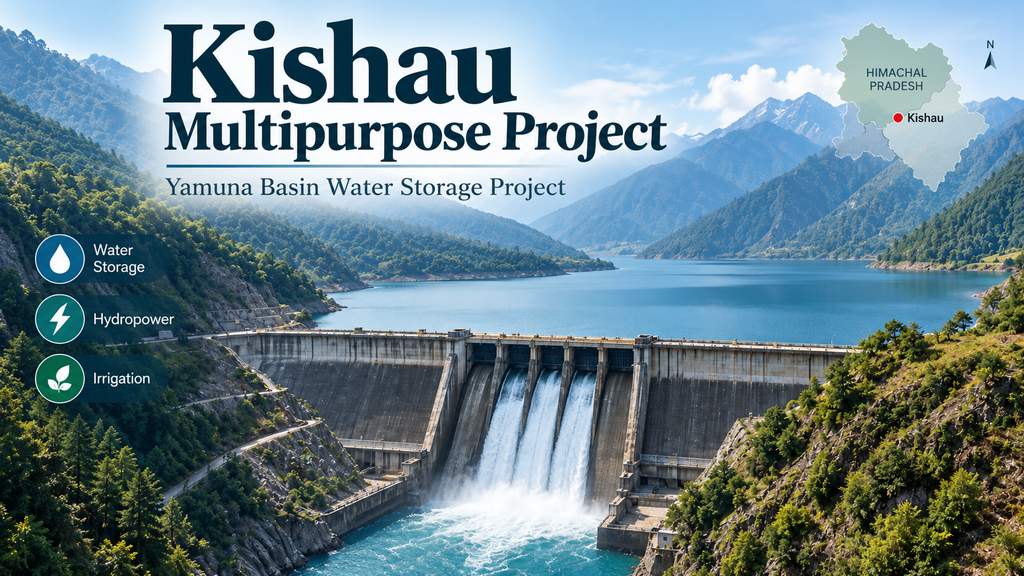
The Kishau Multipurpose Project has come into focus after six Yamuna basin states signed an agreement to move ahead with the long-pending project. Located on the Tons River along the Himachal Pradesh–Uttarakhand border, the project is significant for water storage, irrigation, hydropower and Yamuna river management.
Exam Relevance
UPSC: Prelims | GS-II – Centre-State Relations & Cooperative Federalism | GS-III – Water Resources, Infrastructure and Environment
HPAS/HAS: Prelims | Mains | Himachal Pradesh Geography, Economy, Environment and Current Affairs
Why in News?
The Chief Ministers of Himachal Pradesh, Uttarakhand, Uttar Pradesh, Haryana, Rajasthan and Delhi recently signed an agreement in New Delhi for the implementation of the long-pending Kishau Multipurpose Project.
The project had remained stalled for several years because of disagreements over cost sharing, distribution of water benefits and the financial burden on participating states, particularly Himachal Pradesh.
With the latest agreement, a major inter-state hurdle has been resolved and the project is expected to move ahead for further approvals.
What is the Kishau Multipurpose Project?
The Kishau Multipurpose Project is a proposed storage dam and hydropower project on the Tons River, an important tributary of the Yamuna.
The project is located along the Himachal Pradesh-Uttarakhand border, covering parts of:
- Sirmaur district – Himachal Pradesh
- Dehradun district – Uttarakhand
It has been conceived as a multipurpose project aimed at providing water storage, irrigation, drinking water, hydropower generation and regulated flow in the Yamuna River system.
Key Features
| Feature | Details |
|---|---|
| River | Tons River |
| River Basin | Yamuna Basin |
| Location | Himachal Pradesh-Uttarakhand border |
| Type of Dam | Concrete gravity dam |
| Height | About 232.6 metres |
| Main Purpose | Water storage, irrigation and hydropower |
| Irrigation Potential | Around 97,000 hectares |
| Annual Hydropower Generation | Around 1,476 million units |
| Beneficiary States | HP, Uttarakhand, UP, Haryana, Rajasthan and Delhi |
Importance of the Tons River
The Tons River is a major tributary of the Yamuna.
It originates in the Himalayan region and joins the Yamuna near Kalsi in Uttarakhand. The river carries a significant volume of water and forms an important part of the Upper Yamuna river system.
Why Was the Kishau Project Planned?
The project forms part of a broader strategy to create storage infrastructure in the Upper Yamuna Basin.
The Upper Yamuna basin states signed an agreement in 1994 for sharing the utilisable waters of the Yamuna.
One of the major concerns was the absence of adequate storage infrastructure in the upper reaches of the river. A large quantity of water flows downstream during the monsoon season, while water scarcity becomes more severe during lean months.
To address this seasonal imbalance, three major storage projects were identified:
| Project | River |
|---|---|
| Kishau Project | Tons |
| Renukaji Project | Giri |
| Lakhwar Project | Yamuna |
These projects are intended to store excess monsoon water and release it in a regulated manner during periods of lower river flow.
Yamuna Water-Sharing Agreement, 1994
An MoU for the allocation of Yamuna waters was signed in May 1994 among the basin states.
The annual utilisable flow of Yamuna water was estimated at around 11.983 billion cubic metres (BCM).
The original allocation was:
| State | Water Allocation |
|---|---|
| Haryana | 5.730 BCM |
| Uttar Pradesh | 4.032 BCM |
| Rajasthan | 1.119 BCM |
| Delhi | 0.724 BCM |
| Himachal Pradesh | 0.378 BCM |
After the creation of Uttarakhand in 2000, a portion of the water earlier allocated to undivided Uttar Pradesh was assigned to Uttarakhand.
The agreement forms an important institutional basis for cooperation among the Upper Yamuna basin states.
Why Was the Kishau Project Delayed?
The project faced prolonged delays mainly because of disagreements over financial contributions and distribution of benefits.
1. Cost-Sharing Dispute
Himachal Pradesh raised concerns over the amount it was expected to contribute towards the project’s power component.
The state argued that such a financial contribution could place an excessive burden on its finances.
2. Unequal Distribution of Benefits
A major concern was that a substantial share of the water benefits would go to downstream states such as:
- Delhi
- Haryana
- Rajasthan
- Uttar Pradesh
At the same time, Himachal Pradesh and Uttarakhand would bear a significant part of the project’s local environmental and social impacts.
3. Submergence and Displacement
Large storage projects involve acquisition and submergence of land.
Earlier studies indicated that the Kishau reservoir could affect several villages and thousands of residents across Himachal Pradesh and Uttarakhand.
This makes rehabilitation, resettlement and adequate compensation important components of project implementation.
How Was the Deadlock Resolved?
A major breakthrough came in June 2026, when the Centre and participating states reached consensus on a new financing arrangement.
Under the agreed framework, the Central Government will provide around 90% assistance for the water component, while the remaining share is to be borne by participating states.
A special arrangement was also worked out for Himachal Pradesh.
Under the proposed mechanism:
- Himachal Pradesh’s allocated water share can be transferred to Delhi and Rajasthan.
- In return, Delhi and Rajasthan will contribute towards Himachal Pradesh’s share of the project’s power-related cost.
- Himachal Pradesh can also receive economic benefits from the sale or supply of electricity.
This arrangement attempts to balance the costs borne by the upstream state with the benefits received by downstream states.
Significance of the Project
1. Water Security
The project will create storage capacity in the Upper Yamuna Basin.
Stored water can be released during periods of low river flow, improving the reliability of water availability.
This is particularly important for water-stressed regions of northern India.
2. Irrigation
The project is expected to provide irrigation benefits to approximately 97,000 hectares of agricultural land.
Improved irrigation can help:
- reduce dependence on rainfall,
- increase agricultural productivity,
- improve cropping intensity.
3. Drinking and Industrial Water
The project is expected to support drinking and industrial water requirements of downstream states, particularly:
- Delhi
- Haryana
- Rajasthan
- Uttar Pradesh
With increasing population and urbanisation, long-term water security has become an important challenge for these states.
4. Hydropower Generation
Kishau will also generate clean hydropower.
Hydropower contributes to India’s renewable energy transition and can help meet peak electricity demand.
However, large hydropower projects in the Himalayan region must be developed after careful geological and environmental assessment.
Significance for Himachal Pradesh
For Himachal Pradesh, the project involves both opportunities and challenges.
Potential Benefits
- Revenue from hydropower
- Improved infrastructure in project-affected areas
- Employment opportunities
- Possible financial compensation from beneficiary states
- Greater role in inter-state water negotiations
Major Concerns
- Land submergence
- Displacement of local population
- Loss of agricultural and forest land
- Ecological impact
- Rehabilitation and resettlement challenges
Thus, the project highlights the broader issue of balancing development with ecological and social concerns in Himalayan states.
Role in Yamuna Rejuvenation
Another important objective of the project is to improve the regulated flow of water in the Yamuna.
During lean seasons, reduced river flow contributes to deterioration in water quality, especially in heavily urbanised stretches.
Controlled release of water from storage projects such as Kishau may help improve the river’s flow.
However, additional water alone cannot solve Yamuna pollution.
Effective river rejuvenation also requires:
- treatment of untreated sewage,
- control of industrial effluents,
- protection of floodplains,
- maintenance of environmental flows,
- improved urban wastewater management.
Therefore, Kishau should be viewed as one component of a larger integrated Yamuna River Basin management strategy.
Kishau Project and Cooperative Federalism
The project provides an important example of cooperative federalism.
Several states share the Yamuna river system, but the geographical location of water resources and the distribution of their benefits are unequal.
Upstream states may bear:
- land acquisition costs,
- environmental impacts,
- displacement,
- infrastructure burden.
Downstream states may receive a larger share of:
- irrigation water,
- drinking water,
- industrial water.
The Kishau agreement demonstrates how negotiations involving the Centre and multiple state governments can be used to develop mechanisms for sharing both costs and benefits.
Constitutional Dimension
Water is primarily a State List subject under Entry 17 of the Seventh Schedule.
However, regulation and development of inter-state rivers can come under the Union Government through Entry 56 of the Union List.
Article 262 of the Constitution also provides for adjudication of disputes relating to waters of inter-state rivers and river valleys.
The Kishau Project is therefore relevant for understanding the constitutional dimensions of inter-state river-water management.
Environmental Concerns
Large dams in the Himalayan region require careful environmental assessment because the region is:
- geologically young,
- ecologically sensitive,
- prone to landslides,
- vulnerable to earthquakes and extreme rainfall events.
Major concerns associated with the Kishau Project may include:
- forest diversion,
- habitat loss,
- river ecosystem alteration,
- sedimentation,
- displacement,
- cumulative impact of multiple dams.
Proper Environmental Impact Assessment (EIA), catchment-area treatment and rehabilitation measures will therefore be essential.
Way Forward
The signing of the agreement is an important step, but several issues will require attention during project implementation.
The authorities should ensure:
- transparent cost and benefit sharing,
- fair compensation to affected families,
- effective rehabilitation and resettlement,
- scientific environmental-impact assessment,
- maintenance of environmental flows,
- disaster-resilient dam design,
- participation of local communities,
- cumulative assessment of projects in the Upper Yamuna Basin.
Conclusion
The Kishau Multipurpose Project represents an important initiative for strengthening water storage and management in the Upper Yamuna Basin.
Apart from irrigation, drinking water and hydropower benefits, the project is significant because it demonstrates the complexities involved in sharing river resources among several states.
For Himachal Pradesh, the project is particularly significant because the state has to balance the economic benefits of hydropower and inter-state cooperation with concerns related to land, ecology, displacement and rehabilitation.
The successful implementation of Kishau will therefore depend on ensuring that water security, federal cooperation, environmental sustainability and the interests of affected communities are addressed together.