

Anaimangalam Copper Plates Returned to India
Why in News?
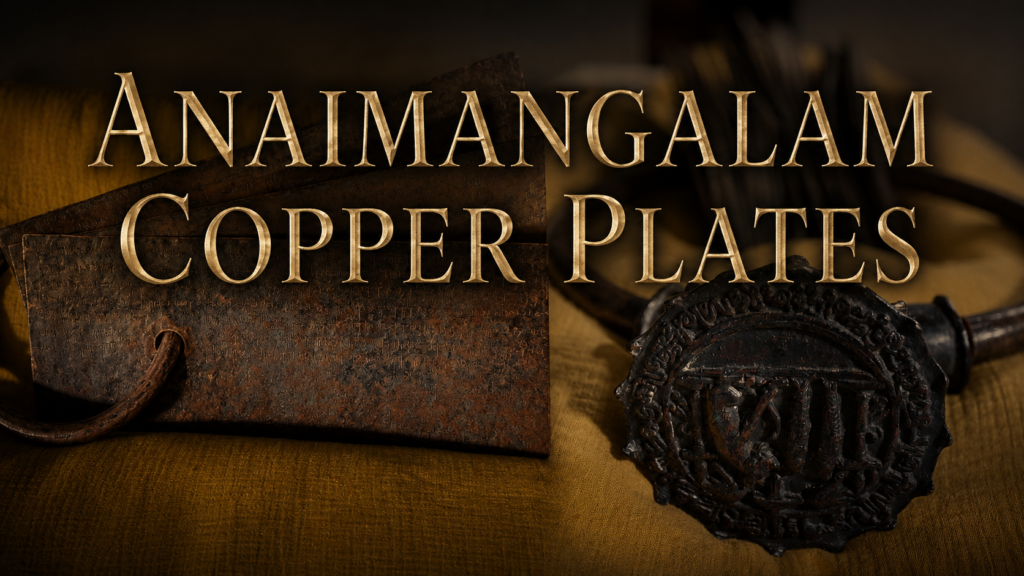
Anaimangalam Copper Plates, also known as the Leiden Plates, are 11th-century Chola-era inscriptions that record land grants, maritime links and religious pluralism during the reigns of Rajaraja Chola I and Rajendra Chola I. Recently, these historic plates came into news after the Netherlands returned them to India marks an important moment in India’s cultural heritage diplomacy and brings back one of the most significant surviving records of the Chola Empire. The restitution ceremony took place on May 16, 2026, and the plates were handed over in the presence of Indian and Dutch leadership.
These plates are not merely ancient artefacts; they are a documentary record of India’s maritime links, administrative sophistication, religious pluralism, and cultural exchanges with Southeast Asia during the peak of Chola power.
About the Anaimangalam Copper Plates
The Anaimangalam Copper Plates are a set of royal copper-plate inscriptions associated with the Chola dynasty. They are known as the Leiden Plates because they were preserved for a long time at Leiden University Library in the Netherlands.
The collection includes 21 plates, weighing nearly 30 kg in total. They are bound together by a bronze ring bearing the royal seal of Rajendra Chola I.
The inscriptions are mainly connected with the reign of Rajaraja Chola I and his son Rajendra Chola I. Rajaraja Chola I ruled from 985 CE to 1014 CE and was one of the greatest rulers of the Chola dynasty. His son Rajendra Chola I further expanded Chola power and influence across South India and beyond.
Language and Structure of the Inscriptions
The copper plates contain inscriptions in both Sanskrit and Tamil.
The Sanskrit section provides a detailed genealogy of the Chola rulers and links the dynasty to legendary and mythological lineages. This was a common practice in royal inscriptions to strengthen political legitimacy and establish the ruler’s divine or heroic ancestry.
The Tamil section records the administrative and grant-related details. It documents the grant of revenues and taxes from Anaimangalam village to the Chudamani Vihara, a Buddhist monastery located at Nagapattinam in present-day Tamil Nadu.
Link with Chudamani Vihara and Srivijaya Kingdom
One of the most important aspects of the Anaimangalam Copper Plates is their reference to the Chudamani Vihara, a Buddhist monastery at Nagapattinam.
The monastery was established by Sri Mara Vijayotunga Varman, the ruler of the Srivijaya kingdom, which was located in present-day Indonesia and surrounding regions of Southeast Asia. The plates record that Rajaraja Chola I granted revenues from Anaimangalam village for the maintenance of this Buddhist institution.
This is historically significant because Rajaraja Chola I was a Hindu ruler, yet he supported a Buddhist monastery built by a Southeast Asian ruler. This reflects the religious tolerance and diplomatic openness of the Chola state.
Historical Significance
1. Evidence of Chola Maritime Power
The Cholas were among the most powerful maritime powers of medieval India. Their naval expeditions, trade networks, and diplomatic relations extended across the Bay of Bengal to Sri Lanka, Southeast Asia, and China.
The Anaimangalam Copper Plates provide strong evidence of the Cholas’ maritime connections with Southeast Asia. They show that South India was deeply connected with the wider Indian Ocean world through trade, religion, diplomacy, and cultural exchange.
2. Religious Pluralism
The plates are an important example of religious pluralism in medieval India. A Hindu Chola king granted revenue support to a Buddhist monastery built by a ruler from Southeast Asia.
This shows that political and cultural relations were not restricted by religious identity. Instead, religious institutions often acted as bridges of diplomacy and cultural exchange.
3. Administrative Sophistication
The Tamil inscriptions contain details of land grants, taxes, revenue rights, and administrative arrangements. This reflects the advanced administrative system of the Cholas.
The Chola state was known for its efficient local administration, revenue collection system, temple-based economy, irrigation networks, and detailed record-keeping. The Anaimangalam Copper Plates are a valuable source for understanding this governance structure.
4. Cultural Exchange between India and Southeast Asia
The plates highlight the strong civilizational links between South India and Southeast Asia. The Srivijaya kingdom had close commercial and religious ties with the Cholas.
The construction of a Buddhist monastery in Nagapattinam by a Srivijaya ruler shows how ports and religious institutions played an important role in connecting cultures across the Indian Ocean.
Journey to the Netherlands
The plates are believed to have left India around the late 17th or early 18th century, during the period of Dutch presence in Nagapattinam. They eventually reached the Netherlands and were preserved at Leiden University Library, where they became known as the Leiden Plates.
Although scholars studied them for many years, the plates remained outside India and were largely inaccessible to the general public. India had been pursuing their return for several years, and their repatriation is now being seen as a major step in the recovery of Indian cultural heritage from abroad. India had reportedly pursued the return of these plates since 2012.

Importance of Repatriation
The return of the Anaimangalam Copper Plates is important for several reasons.
First, it restores to India a rare and invaluable record of the Chola period. Second, it strengthens India’s efforts to bring back cultural artefacts taken abroad during colonial and early modern periods. Third, it highlights the growing importance of heritage diplomacy in India’s foreign policy.
The repatriation also carries emotional and civilizational value. These plates are not just objects of metal; they preserve a story of India’s political power, maritime confidence, religious tolerance, and international connections nearly a thousand years ago.
Prelims Pointers
Anaimangalam Copper Plates / Leiden Plates: 11th-century Chola copper-plate inscriptions.
Associated rulers: Rajaraja Chola I and Rajendra Chola I.
Languages used: Sanskrit and Tamil.
Related monastery: Chudamani Vihara, Nagapattinam.
Foreign connection: Srivijaya kingdom of Southeast Asia.
Returned by: Netherlands.
Significance: Chola administration, maritime trade, religious pluralism, and India-Southeast Asia cultural links.
Mains Relevance
GS Paper I: Indian culture, medieval Indian history, Chola Empire, art and inscriptions.
GS Paper II: India’s cultural diplomacy and bilateral relations.
GS Paper III / Essay: Heritage conservation, repatriation of artefacts, soft power.