

Global Climate Emergency 2025: WMO Report Highlights Record Heat, Sea Level Rise & Health Risks
Why in News?
The World Meteorological Organization (WMO) released its State of the Global Climate Report 2025 on the occasion of World Meteorological Day, warning that the planet is now in a “state of emergency” due to a record Earth energy imbalance, rising temperatures, and intensifying climate impacts.
About the Report
The State of the Global Climate Report is WMO’s flagship annual publication that provides an authoritative assessment of the Earth’s climate system.
- Prepared with inputs from National Meteorological and Hydrological Services, climate research institutions, and UN agencies
- Tracks key indicators such as:
- Global temperature
- Greenhouse gas concentrations
- Ocean heat content
- Sea-level rise
- Glacier and sea-ice changes
- Complements assessments by the Intergovernmental Panel on Climate Change (IPCC)
Key Findings of the Report
1. Record-Breaking Global Temperatures
- 2015–2025: Hottest decade ever recorded
- 2024: Warmest year (~1.55°C above pre-industrial levels)
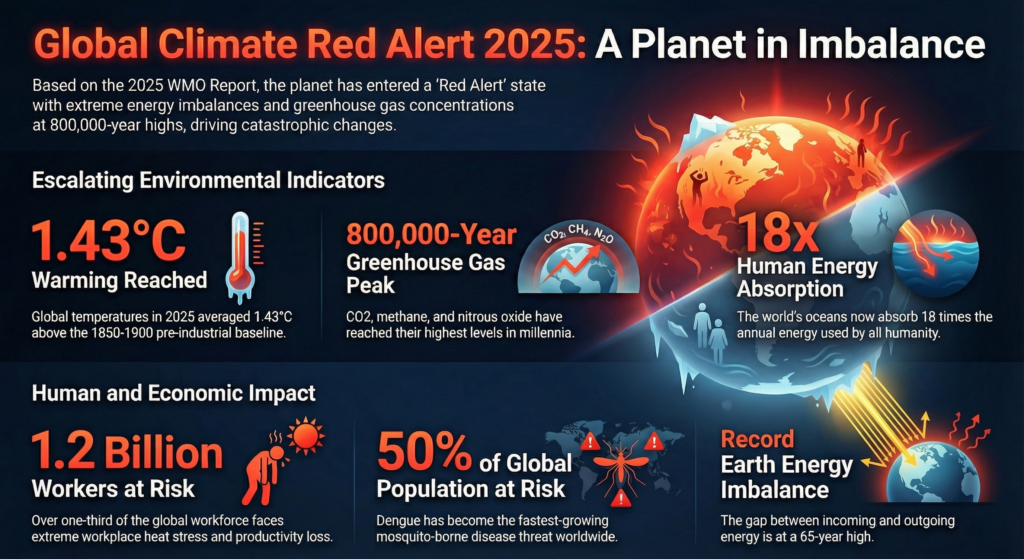
- 2025: Among top 3 warmest years (~1.43°C above baseline)
This trend indicates the world is nearing the 1.5°C threshold, a critical limit under the Paris Agreement.
2. Intensification of Extreme Weather Events
- Increased frequency of:
- Heatwaves
- Floods
- Droughts
- Wildfires and cyclones
- Resulted in:
- Thousands of deaths
- Millions affected
- Massive economic losses
These events are disrupting agriculture, food security, and livelihoods, especially in vulnerable regions.
3. Ocean Warming and Rising Sea Levels
- Oceans absorb over 90% of excess heat
- Ocean warming rate has more than doubled since 1960
- Sea level rise:
- ~11 cm increase since 1993
- Accelerating after 2012
Leads to coastal flooding, saltwater intrusion, and habitat loss.
4. Glacier Melt and Polar Ice Loss
- Glacier mass loss among top 5 worst years recorded
- Arctic and Antarctic sea ice at near-record lows
Contributes directly to sea-level rise and climate instability.
5. Rising Greenhouse Gases and Ocean Acidification
- CO₂ levels at highest in 2 million years
- Methane & nitrous oxide at 800,000-year highs
- Oceans absorbed ~29% of emissions, causing pH decline
Threatens:
- Marine biodiversity
- Fisheries and aquaculture
- Coral ecosystems
6. Earth’s Energy Imbalance (New Indicator)
- Measures difference between incoming solar energy and outgoing heat
- Excess energy distribution:
- Oceans: 90%
- Land: 5%
- Ice melt: 3%
This imbalance is the core driver of long-term global warming.
7. Growing Risks to Human Health
- Over one-third of global workforce exposed to heat stress
- Rise in climate-sensitive diseases like dengue
- Nearly half the global population at risk
- Highlights urgent need for climate-health early warning systems.
Why is the Planet in a “State of Emergency”?
The WMO describes the situation as critical due to:
- Rapid temperature rise nearing dangerous thresholds
- Persistent increase in greenhouse gases
- Accelerating sea-level rise and ice melt
- Intensifying extreme weather events
- Growing socio-economic and health impacts
Together, these trends signal a system-wide disruption of Earth’s climate balance.
Way Forward: Urgent Global Action
1. Strengthening Early Warning Systems
- Improve forecasting and disaster preparedness
- Reduce loss of life and economic damage
2. Climate-Resilient Agriculture
- Develop drought-resistant crops
- Promote sustainable water management
3. Climate Finance
- Support vulnerable and developing regions
- Enhance adaptive capacity
4. Transition to Clean Energy
- Reduce reliance on fossil fuels
- Accelerate shift to renewable energy
Conclusion
The State of the Global Climate Report 2025 delivers a stark warning: the planet is under unprecedented stress. Without urgent, coordinated global action, the frequency and intensity of climate extremes will continue to rise, threatening ecosystems, economies, and human survival.
The report reinforces that the window for action is rapidly narrowing, and decisive steps taken today will determine the future stability of Earth’s climate system.