

Swachhata Hi Seva 2026: Theme, Key Pillars & Importance
Exam Relevance
- UPSC GS-II: Government initiatives, participatory governance, local self-government and sanitation workers’ welfare.
- UPSC GS-III: Environmental pollution, waste management, resource efficiency and sustainable development.
- HPAS: Environmental conservation, public health, local governance and sanitation challenges in Himachal Pradesh.
- Prelims: SHS 2026, Swachh Bharat Mission, FACES parameters and ODF Plus classification.
Why in News?
The Swachhata Hi Seva (SHS) 2026 campaign is being organised from 17 September to 2 October 2026, with the theme:
“Swachhata Mein Sahbhag; Swachh Bharat, Viksit Bharat”.
The campaign emphasises collective ownership, youth participation, sanitation workers’ welfare and sustainable waste-management practices. It also promotes awareness of stakeholder responsibilities under the Solid Waste Management Rules, 2026.
What Is Swachhata Hi Seva?
- About: SHS has been observed annually since 2017, preceding Swachh Bharat Diwas on 2 October.
- Objective: It promotes voluntary citizen participation and shared responsibility for cleanliness under the Jan Bhagidari approach of the Swachh Bharat Mission.
- Community Mobilisation: Citizens, institutions, local bodies and government departments participate in cleanliness activities, awareness programmes and shramdaan, or voluntary community service.
- Evolution: The campaign has expanded beyond cleaning public spaces to include waste management, behavioural change, eco-friendly celebrations and sanitation workers’ welfare.
Important distinction: Swachh Bharat Mission is the broader sanitation programme, while Swachhata Hi Seva is an annual mobilisation campaign supporting its objectives.
What Are the Five Core Activity Pillars of SHS 2026?
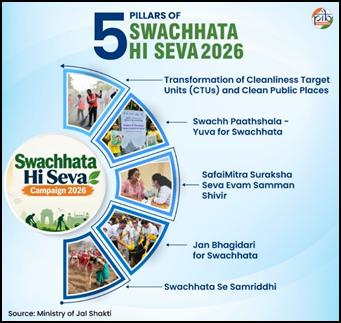
1. Transformation of Cleanliness Target Units and Clean Public Places
- Cleanliness Target Units (CTUs) include neglected garbage points and difficult-to-clean locations requiring focused intervention.
- Activities combine waste removal, beautification and sustained maintenance to prevent these sites from becoming dumping grounds again.
- The campaign also covers markets, schools, hospitals, transport hubs, parks and water bodies.
- Citizens can report sanitation grievances through the Swachhata App, while identified locations can be mapped on the campaign portal.
Public and community toilets are assessed through FACES parameters:
| Letter | Parameter |
|---|---|
| F | Functional |
| A | Accessible |
| C | Clean |
| E | Eco-friendly |
| S | Safe |
2. Swachh Paathshala – Yuva for Swachhata
- This pillar gives students and youth a dedicated role in creating lasting sanitation habits.
- Students from Classes 6 to 12 participate in Swachhata Gyan Yatras, involving visits to waste-management and sanitation facilities.
- School discussions can cover water conservation, handwashing, menstrual hygiene and safe drinking water.
Significance: Practical exposure helps students understand what happens to waste after it leaves their homes and schools.
3. SafaiMitra Suraksha Seva Evam Samman Shivirs
- These camps focus on sanitation workers and their families.
- Support includes health services, safety equipment and linkages with welfare schemes.
- The initiative recognises workers’ contribution while drawing attention to safer working conditions.
Significance: Sustainable sanitation requires both clean surroundings and the safety, dignity and welfare of those maintaining them.
4. Jan Bhagidari for Swachhata
- Encourages citizens and institutions to take responsibility for everyday cleanliness.
- Activities include demonstrations of four-way source segregation, home composting awareness and campaigns against littering and single-use plastics.
- Rallies, public pledges and collection drives for reusable household items support community participation.
- “Swachh Parv, Harit Parv” promotes eco-friendly and plastic-free festival practices.
Significance: Public participation connects individual behaviour with the effectiveness of municipal and village sanitation services.
5. Swachhata Se Samriddhi
- Links cleanliness with resource recovery and the circular economy.
- Promotes the 3R approach—Reduce, Reuse and Recycle.
- Kabaad Se Jugaad: Creating useful products from discarded materials.
- Kabaad Se Kala: Creating artwork from waste materials.
Significance: Waste can become a resource when materials are properly separated, recovered and reused.
What Other Activities Are Planned?
According to the PIB backgrounder:
- 1 October 2026: Simultaneous cleanliness activities under “Ek Din, Ek Ghanta, Ek Saath”.
- 2 October 2026: Special Gram Sabhas to discuss campaign activities and waste-management responsibilities.
- Urban local bodies: Special Council Meetings to support local discussion and action.
These platforms can connect public participation with local planning, accountability and follow-up.
What Are the Key Facts About Swachh Bharat Mission?
- Launch: 2 October 2014.
- Purpose: Improve sanitation, eliminate open defecation and strengthen cleanliness and waste-management systems.
- Logo: Mahatma Gandhi’s spectacles symbolise the association between cleanliness and social responsibility.
Components of the Mission
| Component | Main focus |
|---|---|
| Swachh Bharat Mission–Grameen (SBM-G) | Rural sanitation, toilet access and use, and solid-liquid waste management |
| Swachh Bharat Mission–Urban (SBM-U) | Urban sanitation, waste management, public spaces and cleanliness infrastructure |
Rural India was declared Open Defecation Free in 2019. Sustaining toilet use and maintaining sanitation facilities remain continuing responsibilities.
What Is ODF Plus?
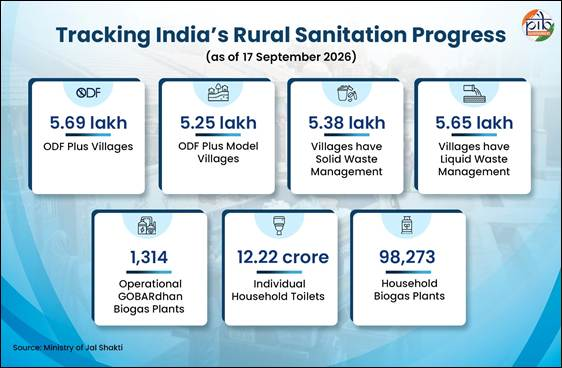
ODF Plus represents progress beyond eliminating open defecation towards improved waste management and village cleanliness.
All three categories require the village to sustain its ODF status.
| Category | Additional requirements |
|---|---|
| ODF Plus Aspiring | Arrangements for either solid waste management or liquid waste management |
| ODF Plus Rising | Arrangements for both solid and liquid waste management |
| ODF Plus Model | Both waste-management arrangements, visual cleanliness and ODF Plus awareness messaging |
Prelims distinction: Every ODF Plus village need not have achieved Model status. The categories represent different levels of progress.
The PIB backgrounder reports that, as of 17 September 2026, India had:
- Over 5.69 lakh ODF Plus villages.
- More than 5.25 lakh ODF Plus Model villages.
These are dated administrative figures and should be quoted with their reference date.
Why Is the Campaign Important for Governance and Development?
- Participatory Governance: Citizens help identify sanitation problems and contribute to local solutions.
- Public Health: Better sanitation and waste management can reduce exposure to contaminated surroundings and disease vectors.
- Environmental Protection: Preventing open dumping and burning helps protect water bodies, soil and air quality.
- Social Inclusion: Accessible toilets and safer sanitation services benefit women, children, older persons and persons with disabilities.
- Circular Economy: Segregation, composting and recycling help recover materials and reduce the waste requiring final disposal.
- Behavioural Change: Repeated community engagement can make responsible waste disposal an everyday practice.
The campaign also supports SDG 6—Clean Water and Sanitation, SDG 11—Sustainable Cities and Communities, and SDG 12—Responsible Consumption and Production.
What Challenges Need to Be Addressed?
- Temporary Cleanliness: Sites may accumulate garbage again if collection services and monitoring remain weak.
- Infrastructure Gaps: Public awareness alone cannot compensate for inadequate toilets, waste-processing facilities or collection systems.
- Mixing of Segregated Waste: Mixing during collection and transportation weakens recycling and discourages household participation.
- Local Capacity Constraints: Limited funding, staff and technical expertise can affect implementation.
- Worker Safety: Recognition must translate into regular healthcare, protective equipment, training and safer work practices.
- Measurement Gaps: Numbers of events and participants do not necessarily demonstrate sustained improvements in sanitation.
Mains insight: Citizen participation strengthens sanitation services, but it cannot substitute for the institutional responsibilities of government and local bodies.
What Is Its Relevance for Himachal Pradesh?
- Tourism Pressure: Seasonal visitor inflows increase waste generation in tourist destinations, markets and transport centres.
- Difficult Terrain: Scattered settlements and steep slopes can make collection and transportation expensive.
- Sensitive Water Sources: Dumping near streams and drainage channels can affect water quality and downstream communities.
- Local Solutions: Panchayats, urban local bodies, hotels, schools and community groups can coordinate segregation, composting and litter prevention.
- Green Celebrations: Eco-friendly fairs, festivals and tourism activities can reduce disposable-material waste.
These considerations make decentralised waste management and community participation particularly relevant to the state.
What Should Be the Way Forward?
- Ensure Year-Round Maintenance: Assign responsibility for every transformed CTU and review whether dumping recurs.
- Connect Awareness with Reliable Services: Maintain segregation throughout collection, transport and processing.
- Strengthen Local Institutions: Improve funding, staffing, technical support and grievance redressal.
- Protect Sanitation Workers: Combine welfare access with mechanisation, training and occupational safety.
- Prioritise Waste Prevention: Encourage reduced consumption, reuse and repair before recycling.
- Measure Outcomes: Track functional toilets, segregation quality, waste processing, worker safety and sustained cleanliness.
Conclusion
Swachhata Hi Seva 2026 places shared responsibility and community participation at the centre of sanitation. Its lasting success will depend on converting campaign activities into reliable public services, safer working conditions and everyday habits that support a clean and inclusive India.
“Sanitation outcomes depend as much on behavioural change and local governance as on infrastructure.” Discuss with reference to Swachhata Hi Seva and the Swachh Bharat Mission. (250 words)