

Loktak Lake: Largest Freshwater Lake in Northeast India
Why in News?
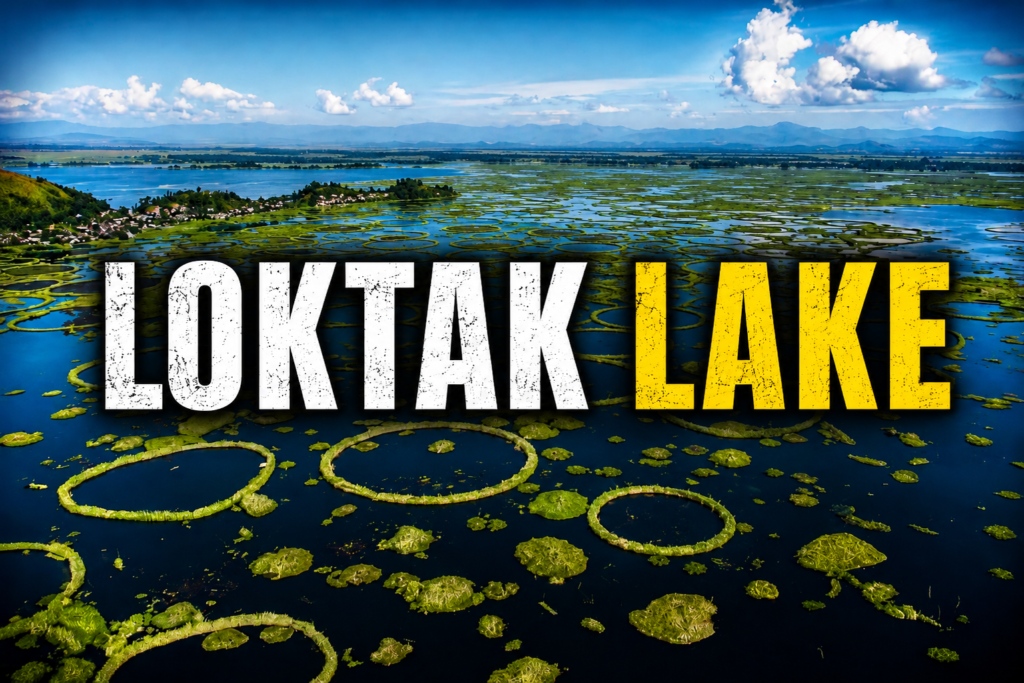
Loktak Lake was recently in the news due to its unique ecological features, especially its floating islands known as phumdis. Located in Manipur, Loktak Lake is one of the most important freshwater ecosystems in India and plays a vital role in supporting biodiversity, local livelihoods, hydropower, fisheries, transport, and tourism.
About Loktak Lake
Loktak Lake is located in the northeastern state of Manipur. It is spread across nearly 287 sq. km and is considered the largest freshwater lake in Northeast India. The lake is widely known for its distinctive floating masses of vegetation, soil, and organic matter called phumdis.
These phumdis give Loktak Lake its unique character. They appear like floating islands and are strong enough to support fishing huts, human settlements, and wildlife habitats. Only about 20% of a phumdi’s thickness floats above the water surface, while the remaining 80% stays submerged.
What are Phumdis?
Phumdis are heterogeneous floating masses made up of vegetation, soil, and decomposed organic matter. They float on the surface of Loktak Lake and form an important part of the lake’s ecosystem.
These floating masses provide shelter and breeding grounds for several species. They are also used by local communities for fishing and settlement purposes. The presence of phumdis makes Loktak Lake one of the most unique wetlands in the world.

Keibul Lamjao National Park
Loktak Lake is also home to Keibul Lamjao National Park, which is considered the world’s only floating national park. The park forms an integral part of the lake ecosystem and is located on the floating phumdis.
Keibul Lamjao National Park is best known as the natural habitat of the endangered Sangai deer, also known as the brow-antlered deer. The Sangai is native to Manipur and holds great ecological as well as cultural significance for the state.
Rivers Draining into Loktak Lake
Several rivers and streams drain into Loktak Lake. These include the Khuga, Western, Nambul, Imphal, Kongba, Iril, Thoubal, Heirok, and Sekmai rivers. These rivers contribute to the lake’s water system and help sustain its ecological functions.
Ramsar Status and Montreux Record
Loktak Lake was designated as a wetland of international importance under the Ramsar Convention in 1990. This recognition highlights its global ecological importance as a wetland ecosystem.
In 1993, the lake was also included in the Montreux Record. The Montreux Record is a register of Ramsar sites where changes in ecological character have occurred, are occurring, or are likely to occur. Loktak’s inclusion in this record shows the ecological pressures and conservation challenges faced by the lake.
Importance of Loktak Lake
Loktak Lake is important for both ecological and economic reasons. It supports rich biodiversity and provides habitat to several species, including the endangered Sangai deer. It also supports local communities through fisheries, transport, tourism, and hydropower generation.
The lake is also a source of livelihood for many people living around it. Fishing activities, floating huts, and tourism-related work are closely linked with the lake’s ecosystem.
Prelims Pointers
Loktak Lake: Largest freshwater lake in Northeast India, located in Manipur.
Famous for: Phumdis, the floating masses of vegetation, soil, and organic matter.
Unique feature: Keibul Lamjao National Park, the world’s only floating national park, is located on Loktak Lake.
Important species: Sangai deer, also known as the brow-antlered deer, is found here.
Ramsar status: Loktak Lake was designated as a Ramsar site in 1990.
Montreux Record: It was included in the Montreux Record in 1993 due to ecological changes.
Significance: Supports biodiversity, fisheries, hydropower, transport, tourism, and local livelihoods.
Mains Relevance
GS Paper I: Geography of India, important lakes, wetlands, and Northeast India.
GS Paper II: Environmental governance, conservation policies, and Ramsar Convention.
GS Paper III: Environment and ecology, biodiversity conservation, wetlands, endangered species, and sustainable development.
Essay: Wetland conservation, ecological balance, biodiversity protection, and community-based conservation.