

Indian Grey Hornbill Reintroduction in Gir | UPSC | HPAS
UPSC Relevance: GS Paper III – Environment and Biodiversity; Wildlife Conservation; Species Reintroduction; Protected Areas
Prelims Focus: Indian Grey Hornbill, Great Hornbill, Gir National Park, IUCN status and ecological role of hornbills
Why in the News?
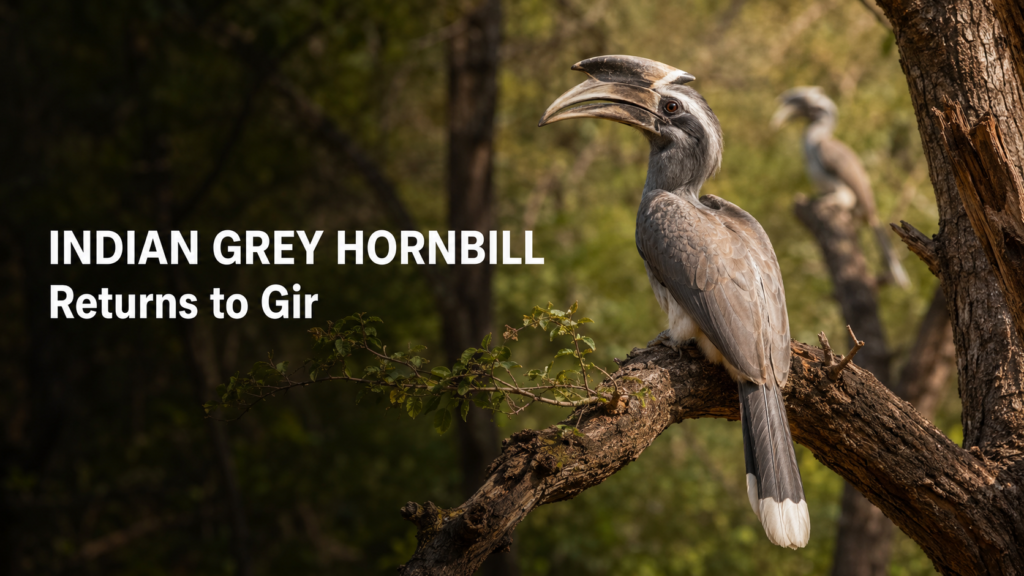
The Indian Grey Hornbill has successfully re-established itself in Gujarat’s Gir landscape after disappearing from the region around the 1950s–60s. Birds reintroduced by the Gujarat Forest Department have established territories, adapted to their habitat and produced offspring.
The programme released 40 hornbills in two phases—28 birds during 2021–22 and another 12 in 2023. Eleven males were fitted with satellite transmitters to monitor their movement, habitat use and breeding behaviour. The birds were sourced from healthy populations in Gujarat’s Aravalli forests after assessments confirmed that Gir offered suitable ecological conditions.
The development is significant because the birth of offspring in the wild is an important indicator that a reintroduced population is progressing towards becoming self-sustaining.
About the Indian Grey Hornbill
The Indian Grey Hornbill (Ocyceros birostris) is a medium-sized arboreal bird belonging to the family Bucerotidae. It is among the most widespread and adaptable hornbill species of the Indian subcontinent.
It is also the state bird of the Union Territory of Chandigarh.
Distribution
The species is native to the Indian subcontinent and occurs across:
- India
- Pakistan
- Nepal
- Bangladesh
Within India, it is widely distributed in the plains and lower hills. Unlike several hornbill species that depend on dense evergreen forests, the Indian Grey Hornbill can survive in human-modified landscapes.
Habitat
It inhabits:
- Open deciduous forests
- Thorn and scrub forests
- Riparian woodlands
- Agricultural landscapes
- Rural settlements
- Urban parks and avenue plantations
Its survival depends significantly on the availability of mature trees that provide fruits and natural cavities for nesting.
Conservation status
| Category | Status |
|---|---|
| IUCN Red List | Least Concern |
| Scientific name | Ocyceros birostris |
| Family | Bucerotidae |
| State bird | Chandigarh |
| Population trend | Generally stable globally, but locally declining in some areas |
Although classified as Least Concern, local populations can disappear because of the removal of mature trees, habitat fragmentation and the loss of nesting cavities. The earlier disappearance of the species from Gir demonstrates that a favourable global status does not necessarily guarantee local ecological security.
Important Characteristics
1. Distinctive appearance
The bird is approximately 60 centimetres long and possesses:
- Greyish-brown plumage
- A pale eyebrow or superciliary stripe
- A long tail tipped with white
- A large, curved bill
- A prominent casque above the bill
The casque of the female is generally smaller and more pointed than that of the male.
2. Arboreal nature
Indian Grey Hornbills spend most of their time on trees. They move between fruit-bearing trees and rarely descend to the ground.
3. Unique flight and calls
They fly through a combination of powerful wing flaps and gliding. Their presence can often be identified through loud, squealing or cascading calls.
4. Monogamous behaviour
The species is generally monogamous and is commonly observed in pairs or small family groups.
5. Omnivorous diet
The Indian Grey Hornbill is primarily frugivorous but also consumes:
- Insects: Lizards: Scorpions:Small rodents: Eggs and nestlings of smaller birds
Ecological Importance
Farmers of the Forest
Hornbills consume a wide variety of fruits and disperse their seeds over considerable distances. Because many seeds pass through their digestive system intact, hornbills contribute to:
- Natural forest regeneration
- Maintenance of plant diversity
- Colonisation of degraded forest patches
- Gene flow among plant populations
- Restoration of ecological connectivity
The decline of hornbills can consequently affect the regeneration of large-seeded forest trees.
Indian Grey Hornbill and Great Hornbill: Comparison
| Feature | Indian Grey Hornbill | Great Hornbill |
|---|---|---|
| Scientific name | Ocyceros birostris | Buceros bicornis |
| Size | Medium-sized | One of the largest hornbills |
| Plumage | Mainly greyish-brown | Black and white with yellow casque and neck |
| Habitat | Deciduous forests, scrublands and urban landscapes | Dense evergreen and moist forests |
| Distribution in India | Widely distributed across much of the subcontinent | Western Ghats, Himalayan foothills and Northeast India |
| IUCN status | Least Concern | Vulnerable |
| State symbol | State bird of Chandigarh | State bird of Kerala and Arunachal Pradesh |
| Adaptability | Relatively adaptable to modified landscapes | More dependent on extensive, mature forests |
| Major threats | Loss of old nesting trees and local habitat degradation | Deforestation, fragmentation and hunting |