

India International Science Festival (IISF) 2025: Theme, Significance, and Key Highlights
Source: PIB
The 11th edition of the India International Science Festival (IISF) 2025 has commenced in Panchkula, Haryana, celebrating India’s growing scientific capabilities and its vision of building an Aatmanirbhar Bharat through science, technology, and innovation. IISF remains one of India’s largest platforms for promoting scientific temper and public engagement with science.
What is the India International Science Festival (IISF)?
Launched in 2015, the India International Science Festival is a national initiative aimed at:
- Showcasing India’s scientific achievements
- Promoting collaboration between people and the scientific community
- Celebrating the spirit of Swadeshi science
- Integrating traditional knowledge systems with modern scientific research
Conceived under the guidance of Prime Minister Narendra Modi, IISF was envisioned as a festival that democratizes science—connecting students, researchers, farmers, artisans, technocrats, and innovators from India and abroad.
Theme of IISF 2025
“Vigyan Se Samruddhi: for Aatmanirbhar Bharat”
The theme highlights the role of science-led development in achieving economic resilience, technological independence, and national prosperity.
Organisers of IISF 2025
- Ministry of Earth Sciences (MoES) – Main organiser
- Indian Institute of Tropical Meteorology (IITM), Pune – Coordinating agency
The festival features 150+ technical and thematic sessions, exhibitions, scientific interactions, startup showcases, and outreach programmes.
Key Focus Areas of IISF 2025
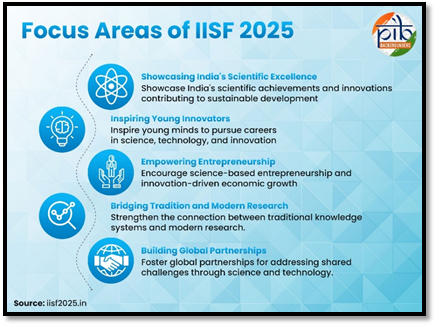
The 11th edition revolves around five broad themes:
- Science, Technology and Ecology of North-West India & the Himalayan Region
- Understanding regional ecology, climate resilience, and environmental sustainability.
- Science for Society and Education
- Promoting STEM education, inclusivity, and scientific temper in communities.
- Aatmanirbhar Bharat through Science and Technology
- Showcasing indigenous technologies, startups, and innovation-led growth.
- Biotechnology and Bio-Economy
- Highlighting India’s growing capabilities in biotech, genomics, and bio-based industries.
- Integration of Traditional Knowledge with Modern Science
- Strengthening the link between India’s ancient knowledge systems and contemporary scientific inquiry.
Evolution of IISF: Previous Editions
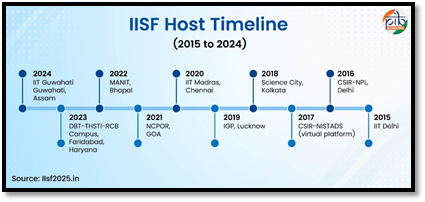
Since its launch, IISF has expanded its scale and impact. The festival has been held across India:
- 2015 & 2016 – Delhi
- 2018 – Kolkata
- 2019 – Lucknow
- 2020 – Chennai (Virtual Format due to COVID-19)
- 2021 – Goa
- 2022 – Bhopal
- 2023 – Faridabad
- 2024 – Assam
Even during the pandemic, IISF ensured continuity by shifting to a virtual mode, maintaining global participation and scientific engagement.
Why IISF Matters
1. Strengthening India’s Scientific Ecosystem
IISF fosters interactions between researchers, industry leaders, innovators, and students, promoting a culture of scientific collaboration.
2. Promoting Public Engagement in Science
The festival aims to make science accessible and enjoyable through exhibitions, competitions, and outreach activities.
3. Supporting Indigenous Knowledge Systems
A core mission of IISF is blending traditional knowledge—Ayurveda, agriculture, architecture, water management—with modern scientific validation.
4. Enhancing Global Scientific Ties
International scientists and institutions participate, enabling cross-border scientific partnerships.
5. Boosting Innovation for Aatmanirbhar Bharat
By showcasing startups, patents, and innovative technologies, IISF supports India’s goal of becoming a global scientific and technological hub.
Conclusion
The India International Science Festival 2025 reinforces India’s commitment to building a scientifically empowered, innovation-driven nation. With its theme, “Vigyan Se Samruddhi: for Aatmanirbhar Bharat,” the festival underscores the role of science in national development, societal wellbeing, and global leadership. By connecting traditional wisdom with modern research, IISF continues to serve as a bridge between India’s rich heritage and its future as a knowledge superpower.